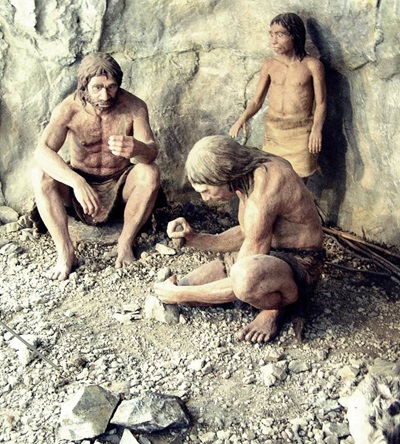
La evidencia del procesamiento de alimentos vegetales es un indicador significativo de la capacidad humana para explotar los recursos ambientales. La recuperación de granos de almidón asociados al uso-desgaste en herramientas de molienda paleolíticas ofrece la prueba de una tecnología específica para la fabricación de harina entre los cazadores-recolectores del Pleistoceno.
En el artículo presentan el análisis de cinco piedras de afilar de dos yacimientos italianos, Riparo Bombrini y Grotta di Castelcivita, ambos habitados durante una fase crucial que abarca el declive de los neandertales y el establecimiento del Sapiens.
La recuperación de granos de almidón en una piedra de afilar musteriense en Bombrini sugiere que los últimos neandertales no solo consumían y procesaban plantas, sino que también fabricaban harina hace 43.000-41.000 años. Los granos de almidón atribuibles a Triticeae en las muelas protoauriñacienses en ambos sitios atestiguan que los sapiens procesaban cereales silvestres hace al menos 41.500-36.500 años cuando se expandieron en Eurasia, mucho antes de los albores de la agricultura.
Estos nuevos datos sugieren un profundo conocimiento de los recursos vegetales disponibles en ambos grupos humanos.
Referencia del artículo:
M. Mariotti Lippi, B. Aranguren, S. Arrighi, D. Attolini, S. Benazzi, F. Boschin, S. Florindi, A. Moroni, F. Negrino, P. Pallecchi, L. Pisaneschi, J. Riel-Salvatore, A. Ronchitelli, A. Revedin,
New evidence of plant food processing in Italy before 40ka,
Quaternary Science Reviews,
Volume 312,
2023,
108161,
ISSN 0277-3791,
Abstract: Evidence of plant food processing is a significant indicator of the human ability to exploit environmental resources. The recovery of starch grains associated with use-wear on Palaeolithic grinding tools offers proof of a specific technology for making flour among Pleistocene hunter-gatherers. Here we present the analysis of five grindstones from two Italian sites, Riparo Bombrini and Grotta di Castelcivita, both inhabited during a crucial phase spanning the decline of the Neanderthals and the establishment of Sapiens. The recovery of starch grains on a Mousterian grindstone at Bombrini suggests that the last Neanderthals not only consumed and processed plants but also made flour 43–41,000 years ago. Starch grains attributable to Triticeae on Protoaurignacian grindstones at both sites testify that Sapiens were processing wild cereals at least 41,500–36,500 years ago when they expanded into Eurasia, long before the dawn of agriculture. These new data suggest a profound knowledge of available plant resources in both human groups.
Keywords: Middle Palaeolithic; Early Upper Palaeolithic; Starch; Grinding stones; Italy